25/26 Season Opener! Breathtaking Barber
LOCATION
Kodak Hall at Eastman Theatre
ARTISTS
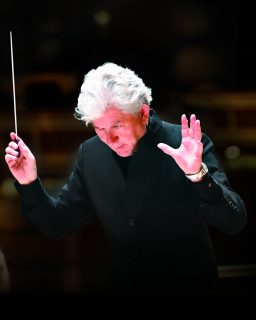
ANDREAS DELFS, CONDUCTOR
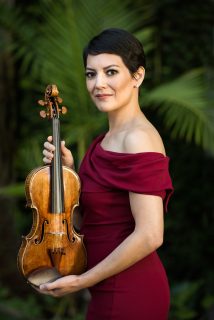
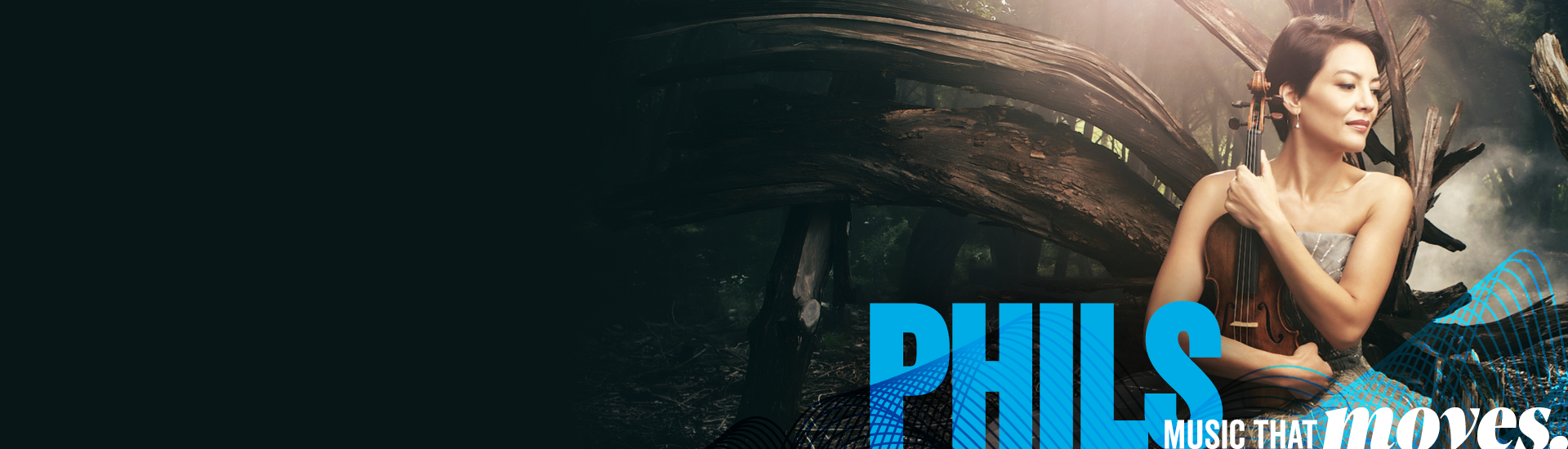
ANNE AKIKO MEYERS, VIOLIN
PROGRAM
MASON BATES
Mothership
SAMUEL BARBER
Violin Concerto
ANTONIN DVOŘÁK
Symphony No. 6
READ THE DIGITAL BRAVO
DESCRIPTION
Sponsored by The Fred M. and Lurita D. Wechsler Endowment Fund
Philharmonics Media Sponsor: 

The lights dim. Music Director Andreas Delfs takes the podium. A low pulse rises—Mason Bates’ Mothership ignites, pulling you into orbit where the orchestra becomes a cosmic vessel, and every note is a signal from the stars. Then Anne Akiko Meyers’ violin breathes life into Barber’s Violin Concerto, its tender melodies unfolding like whispered confessions before erupting into a finale of white-hot virtuosity. And at last, the horizon opens. Dvořák’s Symphony No. 6 sweeps you into a sunlit world of dancing rhythms and pastoral warmth, carrying you toward a jubilant, heart-lifting finale. This isn’t just a concert. It’s a voyage across galaxies, hearts, and homelands to start your RPO’s 102nd season.
VIDEO: Anne Akiko Meyers – NPR Tiny Desk Concert
DENVER POST: Anne Akiko Meyers is the coolest thing to happen to the violin since Stradivari.
RPO HISTORY
Anne Akiko Meyers has performed twice with the RPO, making her debut playing Concerto No. 1 in D major for Violin and Orchestra with Yoav Talmi October 23-26, 2002. She returned February 2-4, 2006 to play The Red Violin: Chaconne for Violin and Orch with Jeff Tyzik conducting.
PRE-CONCERT ACTIVITIES
Join us for a pre-concert chat in Kodak Hall at Eastman Theatre prior to the concert. Maestro Delfs and Julia Figueras will talk in-depth about what to expect with the concert’s programming from 6:30-7 PM (Saturday) and 1-1:30 PM (Sunday). You can sit anywhere you’d like in the theatre; once the chat has concluded, please find your way to your assigned seat.
MERCHANDISE: Anne’s CDs will be available for purchase (credit only) at the marketing table in the orchestra lobby opposite Betty’s Cafe before the concerts and at intermission.
LISTEN
Program Notes:
Mason Bates (Born January 23, 1977)
Mothership for Orchestra and Electronica
An art form best experienced live, classical music struggles to find a place in the era of digital media and on-demand listening. However, there have been notable efforts to bring classical music along in the Internet age. One of those efforts was launched by the London Symphony Orchestra with conductor Michael Tilson Thomas in 2009: an orchestra assembled entirely from worldwide open auditions on YouTube, with the ensuing Carnegie Hall concert streamed on the platform. Although it verged on spectacle, it was a significant event for the classical music world, reaching an unprecedented viewership. The experiment was repeated in 2011, this time with the ensemble converging on the Sydney Opera House, again with Tilson Thomas at the podium. Tilson Thomas commissioned the then 34-year-old composer Mason Bates, who is also a nightclub DJ and electronica artist, to create a piece for the occasion. That work is Mothership.
Bates described it in the program notes: “This energetic opener imagines the orchestra as a mothership that is ‘docked’ by several visiting soloists, who offer brief by virtuosic riffs on the work’s thematic material over action-packed electro-acoustic orchestra figuration.” Bates outlined the work as a scherzo with a double trio, forging a connection to works like Schumann’s Second Symphony. The scherzo is marked by techno beats and cinematic orchestral figurations reminiscent of outer space, a wink towards film composers such as John Williams. The trio sections are as open as interplanetary space, providing room for the ‘docked’ soloists to improvise. The 2011 YouTube Symphony finale concert was, at the time, the largest live stream ever on YouTube, surpassing a live-streamed U2 concert.
Samuel Barber (March 9, 1910 – January 23, 1981)
Violin Concerto
The Barber Violin Concerto is one of those cautionary tales where history has proven initial judgments wrong. A wealthy patron of the young violinist Iso Briselli commissioned the young composer Samuel Barber in 1939 to write a violin concerto shortly after the two musicians graduated from the Curtis Institute of Music. When Briselli brought the first two movements to Albert Meiff, his violin teacher, Meiff aired major concerns. Feeling the piece didn’t fit the violin, he suggested to the work’s commissioner that “major surgery” was needed (and volunteered himself as its surgeon). Briselli quite liked the first two movements but asked Barber for a flashier finale. He got what he asked for – a fiendishly difficult third movement – but Briselli didn’t love it. Barber held steadfast in his creative work and asked Briselli to forgo the rights to the premiere. Instead, violinist Albert Spalding premiered it with the Philadelphia Orchestra in 1941. It was certainly Briselli’s loss; the work became one of the great concertos in the violin repertoire. It’s hard to understand what Meiff’s criticisms were of the first movements. The violin is given unrelentingly sustained lyricism, even over octave leaps, in the first movement, which displays the instrument’s most singing qualities. The second movement is also an intimate, passionate appeal. The finale is in perpetual motion, a knuckle-buster for the violinist. It all features Barber’s brand of modernism, which was neo-Romantic with atmospheric dissonance, welcomed by audiences at a time when twelve-tone and other abstract, atonal experiments were in vogue.
Antonin Dvořák (September 8, 1841 – May 1, 1904)
Symphony No. 6 in D Major
Lively syncopated dance rhythms and exotic, modal inflections are characteristic features of Bohemian folk music, which many Czech composers eagerly incorporated into their concert works. And while the great Czech composer Antonin Dvořák used some of those sounds overtly, such as in his Slavonic Dances, he developed a style of composition that was more a synthesis of influences than an assemblage. It set him apart from his more senior Czech counterpart, Bedřich Smetana, who had more nationalistic aims. Shaped by the cosmopolitan city of Prague, Dvořák was focused on bridging cultural differences, seeking a symbiosis of traditional and mondern sounds in his works, aiming to appeal to both the German-speaking, Austrian public and Czech audiences in Prague. Dvořák’s Sixth Symphony, written for Viennese audiences (a planned premiere that never materialized due to anti-Czech sentiments in Vienna), is a demonstration of how Bohemia’s folk traditions could seamlessly fold into the classical tradition. Even some of the main melodies are architected with the movement and rhythm of Bohemian folk songs, but in this setting sound as stylistically romantic as any might from a culturally German composer.
On the classical side, Dvořák’s influences were, among others, Beethoven, Brahms, and Wagner. Unbeknownst to Dvořák, Brahms, too, became fascinated with the Czech composer’s music with judging a composition competition that Dvořák entered. They forged a friendship, and Brahms helped Dvořák build his reputation in Vienna. Dvořák’s fascination with and indebtedness to Brahms is evident in his Sixth Symphony, which shares the same key, structure, and mood as Brahms’ Second Symphony, written only 3 years prior. Although not overlade, the symphony also has the same luxuriously dense texture as Brahms’ Second; you could almost swim in it. In a letter to his publisher in 1880, after completing the symphony, Dvořák expressed his excitement to show the Sixth Symphony to Brahms, and there is evidence that Dvořák traveleed to Vienna in November 1880 for this purpose. Unfortunately, we don’t have any record of Brahms’ response. Scholars also note some similarities with Beethoven’s Ninth and have mined its themes for related material.
The first movement, Allegro non tanto, is pastoral in character. It grows out of the interval of a fourth, first suggested in the winds before the strings expand it into a full opening theme. A movement in sonata form, Dvořák inventively moves in and out of themes, which seem to change with the countryside winds, also utilizing a rhythmic anacrusis with rustic-like bowing to add a Czech flair and developmental force. The movement finds closure after a pesante march, which dies down before an unexpected final unison fanfare. This is the movement that bests shows Dvořák’s synthesis of folk music with the symphonic tradition. The second movement, an Adagio in ternary form, begins idyllically but transitions into a turbulent middle section, ultimately returning to more sentimental material. The third movement scherzo is a Furiant, a rapid-fire Czech dance, featuring the dance’s characteristic metric alternations, syncopated accentuations, and hemiolas in an exotic minor mode-Dvořák’s most explicit reference to his homeland’s folk sources. The movement was such a hit with Czech audiences that the orchestra was forced to repeat it at the work’s 1881 premiere in Prague. The Finale movement’s dotted rhythm themes also suggest a Bohemian reference, and the main theme’s characteristic interval of a fourth recalls the opening movement. The movement-and symphony-approaches the end with a fugue-like presto before the concluding fireworks.
Program notes by Anna Reguero, PhD, a Rochester-based scholar and arts writer.
Subscribe & Save
Subscriptions for the 2025-26 season are available now—subscribe today to secure your seats!